Monday, May 12, 2008

A News Day?


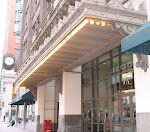
Just back from my niece's wedding near Grand Rapids, in honor of which here is the former building of the Herpolsheimer Co., one of America's most unpronounceable department stores (Hochschild Kohn in Baltimore still being the winner as far as I am concerned).

If you saw the movie of "The Polar Express" there is a wonderful scene where the train appears to pass along Monroe Street in front of Herp's and you can see the store name in gold script to the right. Of course if you had no association with Grand Rapids you would just wonder what it meant. Author Chris Van Allsburg is from Grand Rapids.
< >
And that brings us to the sale of Newsday (no, it doesn't, but I have no good transition here). One has to hope for the best, but these days it's often just hope. The always interesting though increasingly downbeat Alan Mutter writes: "Cablevision’s vision evidently is to develop a holistic advertising sales program that will enable merchants to buy everything from print to cable to Internet from a single representative offering a comprehensive bundle of integrated and interactive services." (I like that phrase "Cablevision's vision.")
Mutter goes on to wonder if that can happen, given the free fall of newspaper revenues, and comes up with ways in which he thinks Murdoch's offer would have made more sense economically -- which are interesting because they relate primarily to print-newspaper marketing and not to a holistic vision. He saw more upside in a Post-Newsday Sunday combination buy, for example, coupled with a joint printing agreement, but as he notes the same thing could have worked for the Daily News. As it is, Cablevision now owns a stand-alone newspaper with a fractional share of the New York metropolitan newspaper market. So all it can do is hope for synergy.
Now for the synergy with this story by Jim Chisholm of Newspapers & Technology. He notes about advertising:
The downward trend in newspaper advertising "has been accelerated by the absurdity of upselling and encouraging converged advertising sales. .... By forcing salespeople to sell print and online together we are encouraging them to focus on the few advertisers who need or wish to buy both together, at the expense of the others.

"Our experience demonstrates that by simply encouraging salespeople to end the month with more advertisers than when the month began, and by compensating them appropriately, the rot can be stopped.

"This habit of replacing loss by selling more space at a higher price to fewer advertisers can no longer be supported. Increasing ad rates has forced smaller companies to look elsewhere. Selling bigger and more frequent insertions has not resulted in advertisers getting a proportionately better ROI.

"Today, as the Web becomes an increasingly significant part of the revenue mix — and more importantly, an important contributor to potential profit and value — it is vital that we revisit these smaller lapsed advertisers.

"We can certainly woo these companies to buy space online, but we also should encourage them back into print, either in the main product or perhaps a niche product."
Will Cablevision assume that its only customers are those who want to buy cable, print and online together? Or will its salespeople simply fall into that default mode? Here, only time will tell. The Harbinger assault on Media General asked for the sale of the Tampa operation that was one of the first and most heralded sites of convergence (a term less used these days). That may be more related to Florida real estate than anything else, but it was interesting.
Is any of this stuff going to be the much-awaited big score, or is it simply that in a more competitive world nothing will ever replace the $1,000-an-inch Sunday help wanted ad, and we should stop looking for the big score and get used to slogging it out in the trenches?


Tuesday, May 6, 2008

Department Store Building of the, oh, whatever


Recently in Richmond, Va., driving on West Broad Street, I drove by what obviously was a former Sears, Roebuck & Co. store. Its identity was confirmed when I was close enough to see a symbol with "SR&Co." on the walls. I pass another old Sears store every day on the way to work.
Former purpose-built Sears stores can be problematic today because when Sears built a store before the Mall Era, it usually was on the edge of downtown or in a neighborhood. (Sears was a pioneer in recognizing the need for parking lots, and also usually had adjacent Farm Stores.) These tend to be in bigger markets; in your typical Anderson or Muncie, Sears just took over a store on the main street.
So their location may mean there's not much call to adapt them or tear them down for new downtown development. On the other hand, that means there are a lot of old department store buildings that exist largely unchanged. Bad for property development, good for nostalgia.
Old Sears stores usually have one or more of three characteristics: A tower, a "classical" style, or yellow or tan brick.
This one on Main Street in Hackensack, N.J., tends toward the Moderne. but it's got the tower and the brick. Best of all is the lettering on the tower, which resembes the logo inside the black circle that Sears used for years before going to the upper-and-lower "Sears" in a square box. I don't know if the tower has historic preservation status, but I hope so; I haven't seen that many old Sears stores, but I've never seen another like this.

Copy Editing: Medal of Honor

I've learned as a copy editor that if there are two things wrong in a sentence, generally a copy editor will catch one. This is in part why you have slots.

It becomes more of a problem when the errors are of different types. Two misspellings in one sentence stand a better chance of being caught than do one misspelling and one factual error. It's the way we're all taught on tests; look for "the error" in this sentence.

Now I have to further amend it to: If you are looking for one thing that might be wrong, you may miss another. We ran a story last week on a winner of the Medal of Honor. Like every good copy editor, I have been told for decades that it is a factual error to call it the Congressional Medal of Honor, even though nearly everyone in America calls it that. As the Wikipedia entry notes, "the Medal of Honor is presented by the president on behalf of the Congress. Although commonplace, the term 'Congressional Medal of Honor' is not correct.'"

So I was making sure that we didn't ever say "Congressional Medal of Honor" and in doing so fell afoul of the other phrasing that often accompanies it, one that also veterans are always quick to point out and which I also knew, but was not looking for and thus overlooked. We referred to the soldier as a "Medal of Honor winner." Medal of Honor etiquette calls for the verb to be "awarded" or "given" or such, not "won," as opposed to service medals. So we got some calls about that.

In my experience, after retired English teachers, retired military are the quickest to call about factual or phrasing issues. Warning to all copy editors: Never, ever call anyone an "ex-Marine." (Anyone except Lee Harvey Oswald, that is.)

Monday, May 5, 2008

Fall in Spring, part II

"TTPB" is honored to have received a post from Jay Rosen, the father of Civic Journalism. If you missed it in the comments, it's here.

Professor Rosen takes me (and others) to task, and indeed does show what happens when one overly conflates one's train of thought. For example, he rightly notes that it is wrong-headed to criticize Civic Journalism as not being a business model, because it never offered itself as one. I do stand somewhat embarrassed.

So this time let me try to get from A to D by going through B and C, and not tar Civic Journalism for the circulation problems of the industry or anything else, because I find a great deal to admire in Civic Journalism. The basic philosophy as I have long understood it (having heard Rosen speak to editors at my paper about it a decade ago, when it was still aborning) is to find out what the readers, and thus starting from there the community, are interested in happen, would like leaders to address, instead of simply quoting and speaking to power elites; and to use the power of the press to initiate methods of bringing people together for discourse, discussion, possible problem-solving, idea generation, instead of waiting to simply quote those who speak out on their own. And then to present those ideas to a candid public (and to those political, civic, national leaders) and not simply reflect the ideas of vested stakeholders, and from this all work together to try to overcome the detachment and alientation people often feel from civic issues. Hope that's close enough and I'm sure it misses nuance but I hope it does not overstate.

Listening to the readers is a good thing. Finding out what they think even if they're not telling you is a good thing. Promoting civic engagement is a good thing. Civic Journalism and its backers are not responsible for people linking it to things that it is not, or misusing its tenets. "Crowdsourcing" is not Civic Journalism (thank heavens I didn't say that, at least). And Civic Journalism never said it was going to solve the financial problems of the newspaper industry or provide any sort of a financial model.

That was where I went from A to D. As Rosen notes, Civic Journalism is something that appeals to Good Government types (I hate the phrase Goo Goos, but he used it, albeit pejoratively, so onward...) My point was not in the end with Civic Journalism is not with it as a philosophy or practice, but with how it by appealing to and supporting the nascent utopianism inside journalism it has, without meaning to, provided an underpinning to other trends that are more pernicious.

Civic Journalism says that one of the highest and best things a newspaper can do is to engage its readership in civic issues. (The root of the original idea, if I remember, was just to get more people to vote.) Well, who could argue? To do this it in part needs to abet, encourage, and provide forums for that readership to engage. Or, creating a conversation. To Civic Journalism's great credit, it said that creating a conversation on civic issues and not just quoting official sources was a legitimate thing for a newspaper to do. There was much debate about this at the time -- that this was breaking down the fourth wall, that it was involving ourselves as partisans, that our job was just to reflect what was being said and not encourage its saying. There still is debate.

But creating and engaging in a "conversation" (as opposed to simply allowing a forum for debate, such as the Letters page) thus became a legitimized thing for a newspaper to do at the moment that technology was allowing anyone to have a much louder voice, through postings, blogs, listservs, whatever. And the "conversation," whatever it was, became an end in itself -- as shown by the virtual incoherence of newspapers that vigorously edit whatever appears in print, allow nearly anything (no matter how erroneous, defamatory, racist or whatever) to be posted on the Web site, and say that this makes no difference in the perception of the newspaper, its brand, what it stands for, in the community. Why? Because to do so is perceived as elitist. (Bob Costas' reaction, which I have been searching for but can't find, to the Buzz Bissinger imbroglio was essentially to say, that anyone who objects to the uncivil, if not savage, tone of comments online is accused of ignoring the voice of the people and thus is dismissed ipso facto.) This goes back to Jefferson and Hamilton, but it puts newspapers in a bind.

If our role is simply to provide a forum for the conversation to happen, and the conversation involves the community, then by definition whatever the conversation is is a legitimate conversation, and far be it from us to say, no, a newspaper is not the place for this. We end up being even more passive than before. So poor struggling Newsweek sees its role as "making itself indispensible to the conversation." But exactly what conversation can Newsweek possibly be indispensible to? The conversation of political elites? The conversation of movie fans? The conversation of airline travelers?

TechDirt's comment on this story noted that "sites will be more successful covering a few topics really well (and attracting a lot of links from other sites for their best coverage) than they will trying to cover every topic and often producing superficial, mediocre coverage. It also means that it's not reasonable to expect that most of a site's traffic will come from people who visit their home page on a daily basis. Rather, traffic is driven by being a part of the online conversation and getting other sites to link to and comment on your work. That's going to be a culture shock for a news organization that is used to having a more or less captive audience of several million subscribers who gets its magazine each and every week."

In fact, Newsweek cannot survive in that environment unless it ceases to be Newsweek. (Link in original, and it's telling, in that it to some degree calls the Wall Street Journal irrevelant and the Christian Science Monitor a vital player.) So for Newsweek to seek its future in the maelstrom of the conversation is, to me, a business model with one outcome, the end of Newsweek. The "conversation" is one of individuals, not of organizations. That has a certain utopian appeal, but in the end is anyone in the conversation disinterested in the way a newspaper or news magazine is supposed to be? I'm probably there because I have an axe to grind. Heck, that's why I'm here.
Professor Rosen is right to point out that none of this inevitably proceeds from Civic Journalism, and I admit my error. (Also, the opinions were sinply mine, so I did not source them.) What I meant to say was that CJ legitimized the concept of journalism's creating and enabling civic conversations to the mainstream media, and that while enabling conversations appeals to the disinterested Goo Goo side of journalists, it is not a business model to pay for creating journalism, and journalists who think it is one simply help create more unemployed journalists. If you think the MSM and journalism is a pack of hooey anyway, unemployed journalists do not bother you at all. But they do bother journalists in the MSM.

I have no idea why Blogger lets me have this space to comment, except that it effectively costs them nothing and I, or you, may follow some link, and clink on something, and some money will be made somehow. As long as Blogger lets me post free, why not? Let someone else worry about the money. But in newsrooms we no longer have that luxury. As my friend Doug Fisher puts it, we can't think we can write our way out of this one. Assembling the community in a virtual agora won't do it either.

Tuesday, April 29, 2008

Media Jones

Because we assume that our readers are, or should be, like us, or that we really in our hearts only want readers who are like us, we overemphasize the role of news junkies in today's media environment.

Who spends most of their day working on a computer -- not monitoring nuclear power plants or fixing problems with air reservations, but working free-form on a computer -- able to regularly, even somewhat obsessively, check various news sites for updates during the day?

Among the people who do are pundits, journalism professors and journalists. Does the typical American worker even have the ability to check in with CNN, USA, two, three, four times a day? Does the typical American worker even care that much? Doctors are seeing patients or operating. Lawyers are seeing clients or in court. Department-store workers are selling goods. Car dealers are selling cars. Linemen are fixing lines.

But how often do you, can you, check Romenesko?

People who make their living working in media have to obsessively monitor media -- to not miss something, but also, that's why they work in media. They have to know, right now. Are they the major component of newspapers' audience? Have they ever been?

How many "death of the newspaper" stories have begun with some variation of, "I used to begin my day with the print edition of the New York Times," or, even better, the Times and the Post. What percentage of the American population ever read the print edition of the New York Times? What percentage of the people writing about the problems of newspapers do or did? (It doesn't matter if they also read their local daily.) Nothing against the New York Times, I'm a media person, I find the New York Times fascinating. It's just that the vast majority of Americans do not read the New York Times.

Journalists and the newspaper business do have to accept that that portion of their audience that began, or wished it began, its day with the New York Times (except for the local audience in New York, which is still considerable) is never coming back to print. If you care that much about the news, you'll get RSS feeds of the Times and the Post and the L.A. Times and CNN and Time and on and on, or you'll spend the day going from one Web site to another.

Which segues in an odd way to this interview with personal finance columnist Scott Burns, who took the buyout in 2006 from the Dallas Morning News. Scott writes about how when he was business editor at the Baltimore News-American, he concluded that newsprint was a terrible way to present stock information. He wrote a code to allow this information to be gotten online.

Scott says this happened in the early 1980s; the News-American closed in 1986, so it was certainly early to mid-. In 1984 was the famous Apple Super Bowl ad. In 1986 there was no World Wide Web. There were barely graphic interfaces. Newspapers used Atex or SII or Hendrix. At home we used a second-generation IBM PC that still had an A drive and had to be booted up through disks. (Yes, we had a PC at our home in 1985. My father had one in 1979; you entered the data using dials. I really am not a technology Luddite.)

Scott was way ahead of the curve, and people who are lead progress. Scott's problem was that in the early 1980s, for the typical person, newsprint was still a wonderful way to give stock prices. It just wasn't for him. The typical person still saw computers as mystical behemoths that were going to take over the world ("Lead us, Landru!"). But for Scott print was already yesterday's outmoded technology.

But most of your media junkies and early technology adopters are not people who read the ads in the newspaper anyway. Some of them never read the B section or Features. (The same thing is true for absolute sports junkies.)

Print newspapers still have a pretty good market among the rest of the population. We can find a way to profitably serve them -- if we want to. But they are not us. And yes, it would be more fun if the audience was composed of people like us.

Fall in Spring, Part II

Two caveats on this previous post:

There's nothing wrong with having a conversation or joining it. The Civic Journalism movement, of which the "join the conversation" emphasis seems to me an outgrowth, is a perfectly fine thing for newspapers to support. The problem is that Civic Journalism is often presented as if its major goals -- increasing public involvement in electoral politics and grappling with the issues of our time -- are, or at least are a major part of, the only true purpose of journalism. A newspaper is, once again, like a department store; it's not a boutique. Civic Journalism and the conversation are a department, maybe on the main floor or mezzanine, but if they are the main thing in the store, not many people are going to come in every day.

Even if those could be our only goals, Civic Journalism and joining the online conversation is not of itself a successful business model for newspapers, as is becoming clearer every month. To be fair, its advocates have never presented it as such. They present it as a civic good and assume therefore that it will find support; because it is in the public interest, the public will somehow arrange for it to work. This has always been a problem with Good Government initiatives.

Of course, if the conversation is about Miley Cyrus' photos, that might be a successful business model, but I doubt it's what Jay Rosen envisioned. But why a daily newspaper would believe that it would become in 2008 the major venue for a conversation about Miley is beyond me.

And the fact that a large number, possibly a third, of our paying print customers appear to use our online offerings as well is a wonderful thing. The seamless garment, to use a religious metaphor. We give it away online and they are still willing to pay for the print product, because they get added value from it. If we give them stuff exclusively in print and then give them other stuff online, instead of giving them the same stuff free, they might still be happy. Of course, they would still want the ability to e-mail to their friends a link to a story they read in the paper. This sort of stuff we can work out. But it seems that promoting print and then having online as added value to print is not a model being rejected by the newspaper marketplace.

Sunday, April 27, 2008

Philadelphia 1965

Driving through Baltimore recently I passed a shopping center on Reisterstown Road that clearly had been a mall marvel at some point in the 1960s, and it brought to mind how many abandoned or destroyed suburban department stores there are. The death of downtown stores was evocative for those of us who grew up on them; but how many relics there are for the 1960s and 1970s now as well.

So from a 1965 Inquirer I made a list of the branches of Philadelphia department stores in that year. Very few are still occupied by Macy's, Penney's or Sears, although there were more than 40 locations at that time. It was a tendency of upscale stores to simply list branch names (usually in the order they were opened) and downscale ones to list locations, but here's where a shopper could have gone that year for department-store shopping. It's an amazing list when one thinks that within a few years, almost all of this had been replaced by malls such as Plymouth Meeting, Oxford Valley, Echelon and the like. Clearly at this time people went "to Sears" or "to Wanamakers" rather than "to the mall."

THE MAIN LINE

Wynnewood: John Wanamaker, as anchor store of a small plaza, and a Bonwit Teller somewhere.
Ardmore: Strawbridge & Clothier, in its earliest suburban location (from the 1920s) and still a Macy's, just up the road from Wynnewood.

St. Davids: Sears, Roebuck & Co. had its Main Line location here; B. Altman & Co. from New York was nearby.

Bala Cynwyd: Saks Fifth Avenue's Philadelphia outpost was here.

MONTGOMERY COUNTY

Jenkintown: Wanamaker, Strawbridge, Bonwits, all at separate locations.

Abington: Sears was on Old York Road, near Wanamakers' Jenkintown store.

Cheltenham: Gimbel Bros. at an early mall.

Willow Grove: Lit Bros.' Montco location at York and Easton Rds.

King of Prussia: Wanamakers and J.C. Penney Co. pioneered what is now the largest mall in the East, and where Macy's still holds court. Nearly every East Coast department store chain has been at King of Prussia at one time or another.

DELAWARE COUNTY

Springfield: Strawbridge, not the current Springfield Mall, however.

69th St., Upper Darby: The great middle-class suburban shopping area of Philadelphia before the mall boom, with Gimbels, Lits, Penney's, Sears.

Lawrence Park: Lits, with I think a branch of a Chester store, Weinberg Bros.

NEW JERSEY

Moorestown, N.J.: Wanamaker and Gimbels at an early mall that still has Macy's, Sears and Boscov's. One of the country's oldest malls.

Cherry Hill, N.J.: The first enclosed mall in America had Strawbridge and L. Bamberger & Co. from Newark. Macy's and Penney's are still there.

Camden: Lits was downtown. Penneys had just moved out. Sears was on the Admiral Wilson Boulevard in what was its first purpose-built store in the nation.

Audubon, N.J.: Penneys had moved to the Black Horse Pike Shopping Center from Camden.

CITY OF PHILADELPHIA

Great Northeast: Gimbels was here in 1965; others came later; Macy's is still here. A couple of blocks away was a Lit Bros. store at Cottman and Castor. Sears had a store with its huge Northeast catalog center down Roosevelt Boulevard.

South Philadelphia: Lits at 23rd and Oregon. Sears a block away.

Germantown: Penney's and Sears were here on Chelten Avenue, along with two local department stores, C.H. Rowell and George Allen Inc., also now gone.

OTHER CITIES

Lits had a downtown store in Trenton and a branch in Morrisville, but Trenton was its own market to everyone else. Lits also was in Atlantic City.

Wanamakers and Strawbridge had made early incursions into Wilmington, Del. Penney's and Sears didn't consider Wilmington part of their Philadelphia markets, and Wilmington had its own department stores (Kennard-Pyle Co. and Wilmington Dry Goods) as well.

The Levittown developments had their own shopping centers (Levittown Shop-A-Rama and Willingboro Plaza); both had Sears, one had Penney's, and both also had outposts of the Reading-based Pomeroy's Inc., which Levitt & Sons apparently had invited in.

Sears advertised its Norristown and Chester locations as part of its Philadelphia operation, but those cities also had their own stores (B.E. Block & Bros. in Norristown, Speare Bros. in Chester).
What an amazing world of department stores it was.

Saturday, April 26, 2008

Fall in Spring

Monday will bring the latest gloom-and-doom FastFax report, and E&P's coverage notes that once again we will see declines of 4 percent in average daily readership, more on Sundays. The article gets more gloomy when it turns to a Scarborough report.

"Gary Meo, senior vice president of print and digital media services at Scarborough Research [said]: 'In general, print [readership] is in a steady decline, and online readership is growing but the declines in print are not being offset by the increases in online readership,' he said. 'The integrated newspaper audience is declining.'

"It's not unlike what is happening with total online revenue where the online revenue growth, while steady, can't make up for the losses in print revenue. Print readership dwarfs online readership so a loss of one percentage point could mean thousands of readers. The percentage gains in online readership may be big, but it's coming off a small base...."

"Meo concedes that it will be difficult for a newspaper to grow its online audience fast enough to make up the loss for print readership. 'The numbers don't work at this point,' he said. But he also pointed out the enormous market penetration newspapers have -- 'more than any other media' he said. 'When you look at these numbers they are pretty staggering. Just the print alone in some markets you get 67% reach. Those are big numbers.'

That's right, newspapers in some markets just in print reach two-thirds of households. Nothing else does that. Yet they're toast, yesterday's technology.

And while online readership is growing, the total newspaper readership in print and online is declining. How much is online adding to print readership? I just defined the top half of the list:

The Atlanta Journal-Constitution: Print 48% of market; print and online together 54%
The Sun : 51% -- 54%
The Blade: 53% -- 55%
The Buffalo News: 64% -- 66%
The Charlotte Observer: 44% -- 47%
The Columbus Dispatch: 58% -- 60%
The Des Moines Register: 70% -- 71%
The Fresno Bee: 48% -- 49%
Houston Chronicle: 51% -- 55%
The Indianapolis Star: 51% -- 53%

In most markets listed in this story. newspapers online reach between 10 and 15 percent of their own market, by Scarborough's estimation. In most markets that reach went up by 1 or 2 percentage points between 2007 and 2008. In most of these markets print reach went down by 2 to 3 percentage points in the same period.

But in nearly every market -- assuming I am reading this correctly -- the addition of online added only 2 or 3 percentage points to the newspaper's total market reach. In those that had the greatest online penetration -- Atlanta, San Diego -- it added five or six.

Which seems to me to mean that the number of people who use online news sites in their own market exclusively -- not who use NYT or USA, not who visit Philly.com to find out about the Eagles -- but "the percentage of adults who have ... visited the Web site ... during the past seven days" in their own market and who didn't read their local print newspaper during the same time -- is about 3 to 4 percent of the market, on average, and that most of the people who knowingly visit our Web site already are our customers in print.

Tell me again why we need to give this away? Tell me again why this is the inevitable future? Tell me again that this is not about the product but simply about the march of technology? That the fact that print penetration rose or held steady in Atlanta, Indianapolis, Portland, Richmond, Syracuse is meaningless?

We've got to separate the future of the newspaper business from the future of Nytimes.com; from the future of political pundits and commentators and bloggers saying that the only purpose of news media is to "join the conversation." Most of that conversation seems to concern readers of the New York Times, not of the 1,300-plus other daily newspapers.

Copy Editing: Policese

Back from a few days in Virginia, where the Miller & Rhoads department store building in downtown Richmond is being turned into a multi-use development (as is much of downtown Richmond, which has much more going on than I had realized); from reading the somewhat free-form Newport News Daily Press and the rather traditional Richmond Times-Dispatch; and from thinking that in an earlier era, the rapid growth around Williamsburg would have led to someone's starting a daily newspaper there. There is a prosperous twice-weekly (owned by Tribune Co., it appears, as is the Daily Press) but it made me wonder if we have seen, in Pikesville and Georgetown, Ky., the last conversions-to-daily-publication that we will see.

Back to the desk. Many, many years ago, an editor with whom I worked, with the wonderful name of Stanfield Gordon Gapper, pointed out two things about police reports: One, that people are always driving at a high rate of speed, as opposed to fast; and two, that people are redundantly reported as "treated and released." If John Smith was treated at Jones Hospital, Gordon said, then he clearly is not there anymore, and thus was released; otherwise it would be either that he "is being treated" or "was pronounced dead." So I have tried over the years to say "Smith was treated at Jones Hospital" and drop the "released" part, though this has caused some controversy.

Lately I've added my own nail to this pot on the construction "Smith was rushed to Jones University Hospital, where he was pronounced dead an hour later." This sentence is written a lot in a city with 400 homicides a year.

First off, people are always "rushed" to a hospital; that's what ambulances do. It would only be newsworthy were he not rushed. But more to the point, why would he be pronounced dead at Jones University Hospital if he had not been taken there? So I have been making it "Smith was pronounced dead an hour later at Jones University Hospital," and no one is complaining that we are implying that poor Smith lay bleeding on a manhole cover for an hour.

So much of police writing stems from the police report's need to account for every action in a court of law. We do not have that same need. With newsholes shrinking, economical writing is imperative.

Saturday, April 19, 2008

Department Store Buildings of the Week, No. 4


Missed last week, so here is a double-header from Elizabeth, N.J.


At left, the gray building was officially Levy Bros. of Elizabeth, N.J., Inc., at 76 Broad St. Levy Bros. started as a women's-wear store and grew in the 1920s into a full-line fashionable department store. At right is the R.J. Goerke Co. building at 100 Broad St. Rudolph Goerke had a department store in Newark, which is six miles from Elizabeth. At the time Elizabeth had just small dry-goods stores, so Goerke and partner E.A. Kirch invaded booming Elizabeth with its first real department store. In the 1920s the Goerke family expanded, buying Lit Bros. in Philadelphia. The Depression put an end to that, the Newark store was closed, and the Goerkes were left with just the Elizabeth store, but soon they were back in an expansionist mode, buying the Rosenbaum Bros. store in Plainfield. Eventually it became part of the Steinbach-Howland-Genung's operation referred to earlier.

Elizabeth had quite a run as a shopping hub, but eventually its suburbs and Newark's and New York's all grew together, and Elizabeth's stores and its newspaper (the Daily Journal) all became irrelevant in the broader suburbs and disappeared.